
Household Injection Molding: Applications, Materials, Mold Design, and Manufacturing Solutions
مقدمة
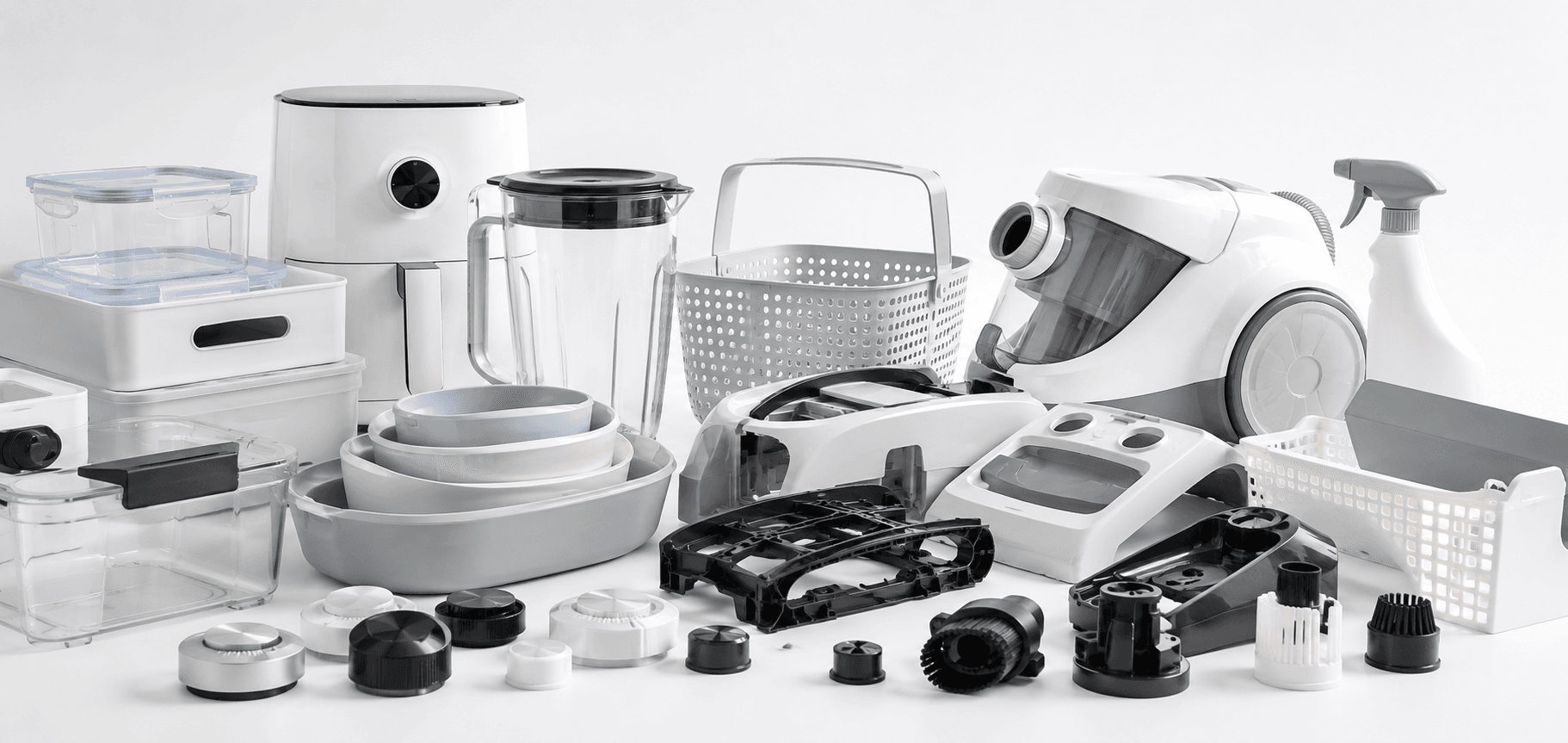
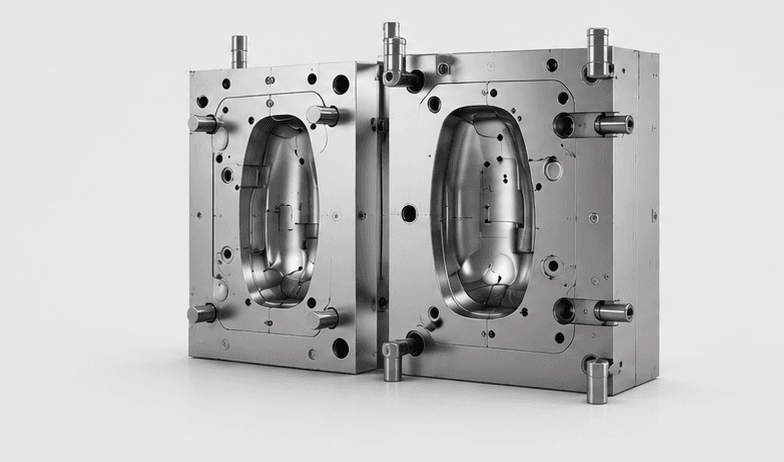
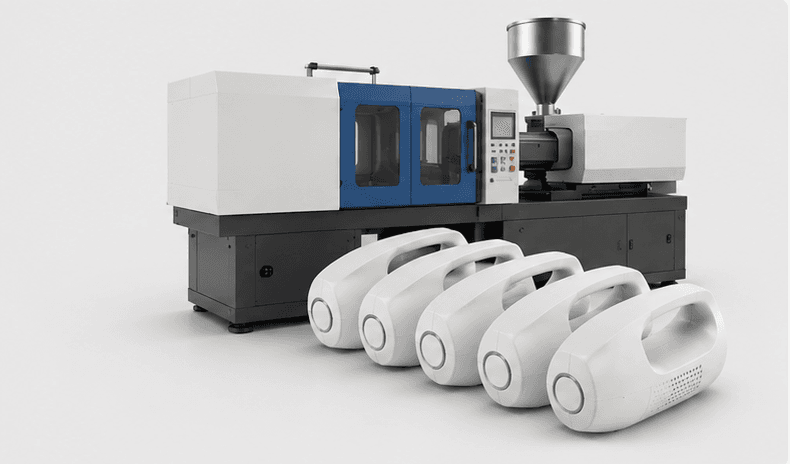
القولبة بالحقن البلاستيكي is one of the most important manufacturing processes used in the household products industry. From kitchen appliances and storage containers to cleaning products, bathroom accessories, furniture components, and electrical appliance housings, injection molded plastics are present in almost every modern home.
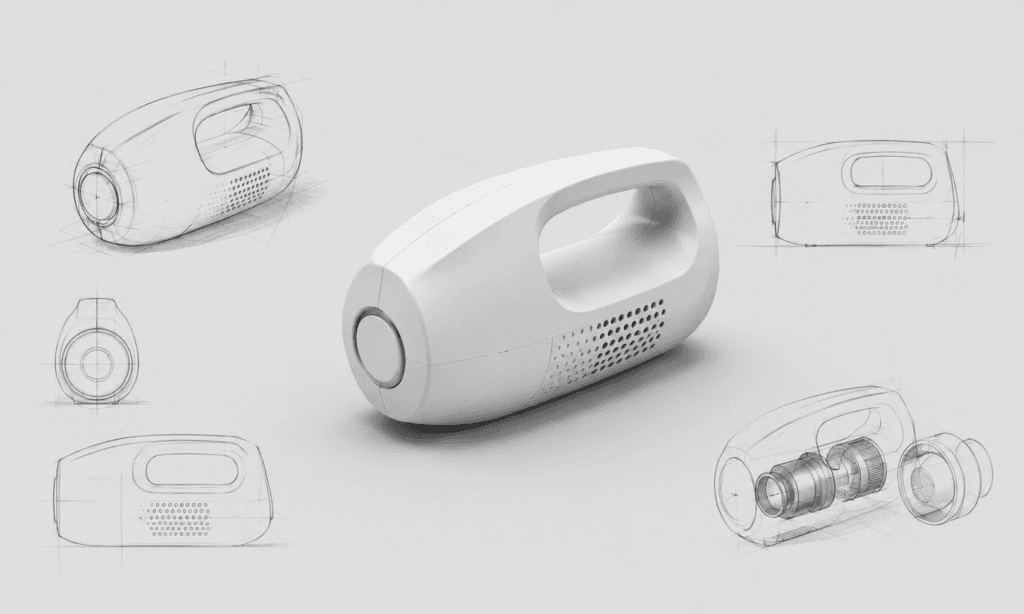
The process is particularly suitable for household products because manufacturers often need high production volumes, consistent dimensions, attractive surfaces, complex geometry, and competitive unit costs. Injection molding also allows several functions—such as ribs, clips, screw bosses, handles, hinges, sealing features, and decorative textures—to be integrated directly into a molded component.
Major engineering-plastics suppliers specifically identify large and small home appliances, food and drinkware, furniture, cookware, and other household goods as important applications for thermoplastics.
Successful household injection molding, however, requires more than choosing an inexpensive plastic. Material performance, appearance, food-contact requirements, heat resistance, electrical safety, mold design, assembly, and long-term durability must all be considered during product development.
1. Injection Molded Parts in Home Appliances
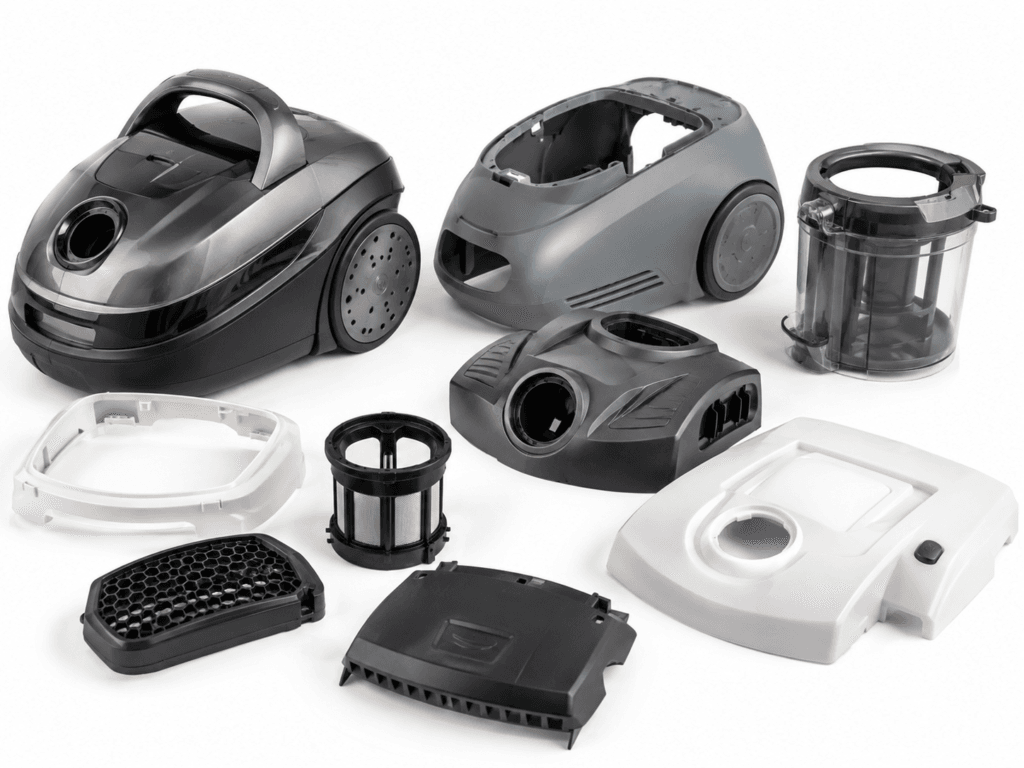
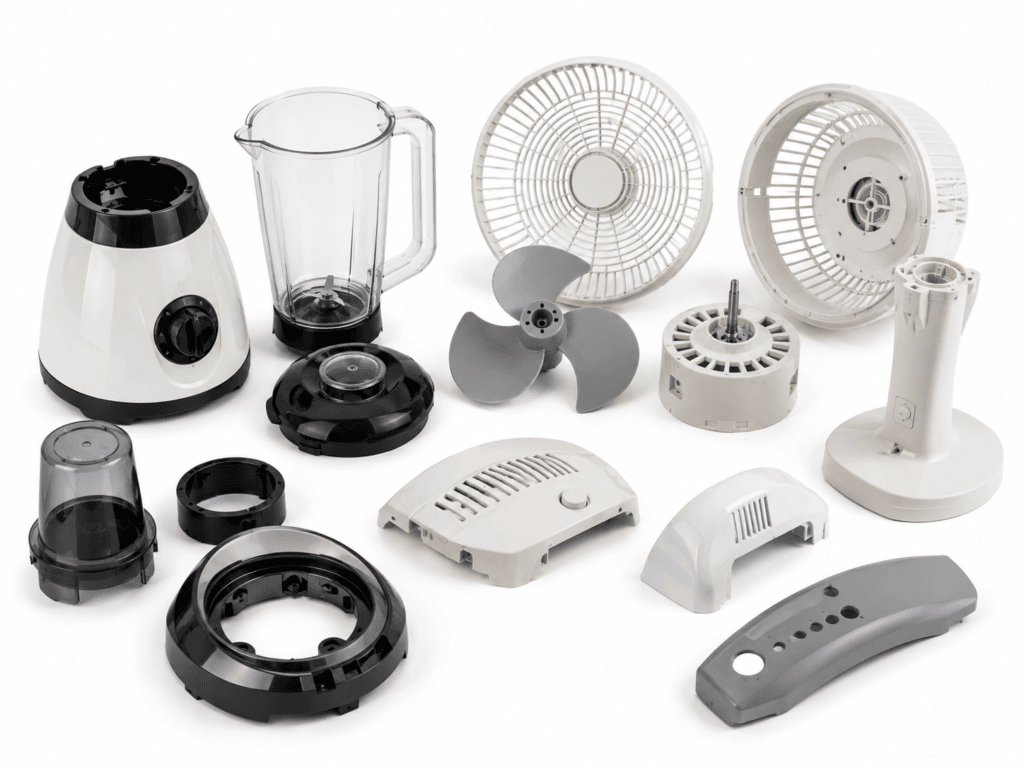
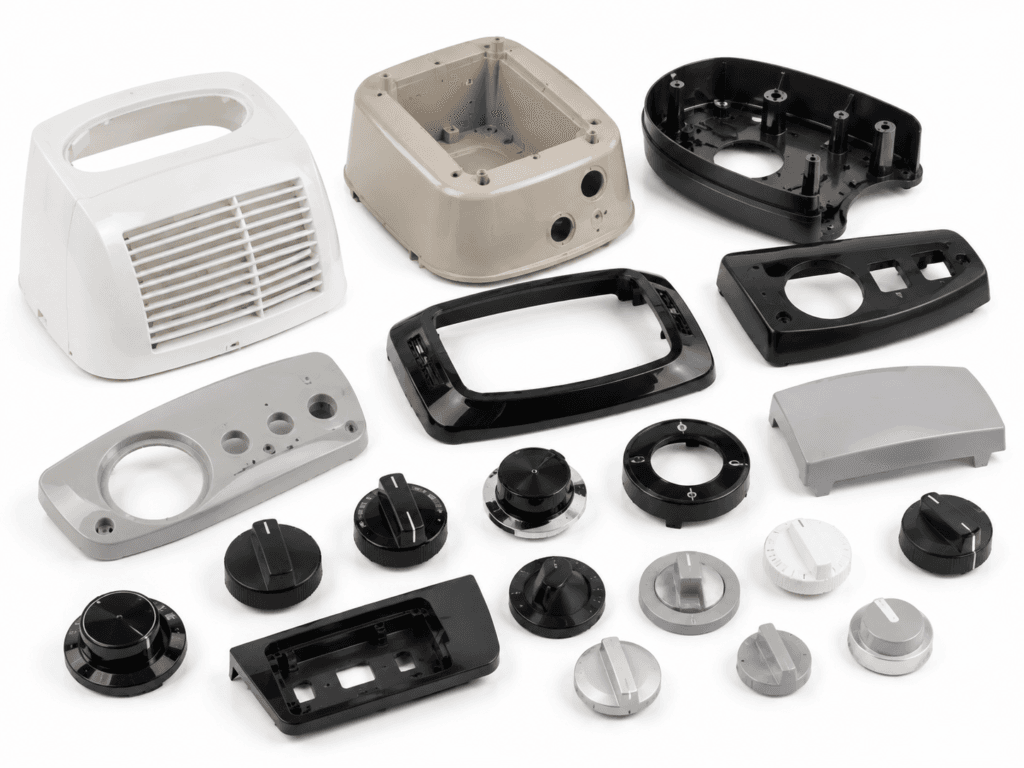
Large and small household appliances contain many injection molded plastic components.
تشمل التطبيقات النموذجية:
- Vacuum cleaner housings
- Coffee machine components
- Electric kettle housings
- Blender bases
- Fan blades and guards
- Washing machine components
- Refrigerator interior parts
- Air purifier housings
- Control knobs
- مبيتات المفاتيح
- Internal brackets
Engineering plastics are valuable because they can combine lightweight construction, electrical insulation, dimensional stability, appearance, and design flexibility. SABIC and Celanese both list home and kitchen appliances as established applications for engineering thermoplastics.
For electrical household appliances, safety requirements must also be considered. The IEC 60335 family addresses the safety of household and similar electrical appliances, with specific parts covering different categories of equipment.
Home Appliance Applications
| مكون | Main Requirement | مادة محتملة |
|---|---|---|
| Appliance Housing | المظهر + مقاومة الصدمات | ABS / PC+ABS |
| Internal Bracket | Strength + dimensional stability | PA-GF |
| غلاف المفتاح | عزل كهربائي | PBT / PC |
| Fan Component | Strength + lightweight | PP / PA |
| Control Knob | Appearance + dimensional accuracy | ABS / POM |
2. Kitchenware and Food-Contact Plastic Products
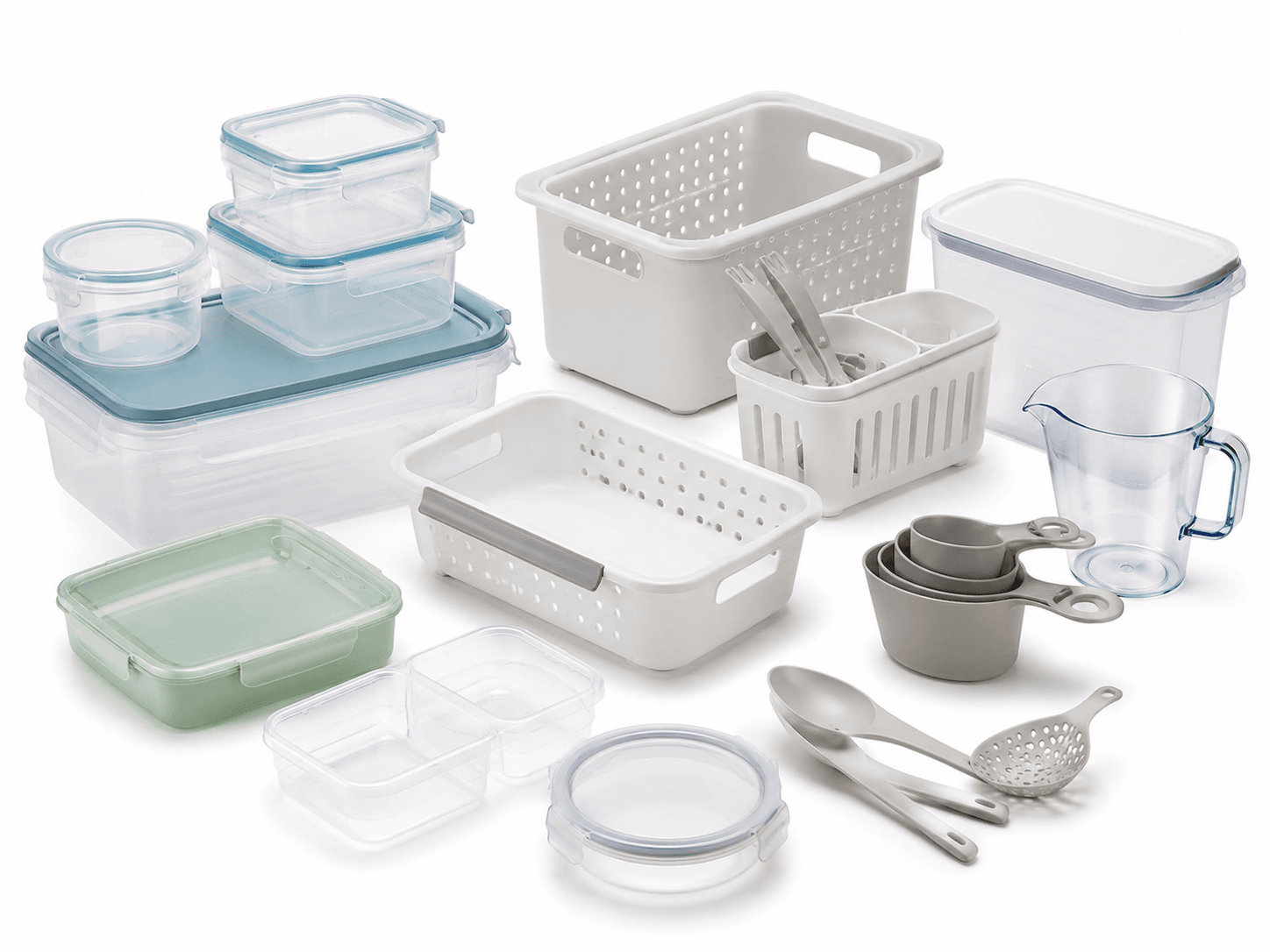
Kitchenware is another major application of injection molding.
Common molded products include:
- Food storage containers
- Measuring cups
- Kitchen organizers
- Utensil handles
- Reusable boxes
- Refrigerator storage trays
- Coffee machine components
- Food preparation accessories
Material selection becomes particularly important when the finished product comes into direct contact with food.
In the United States, FDA rules cover substances used in food packaging, cookware, food preparation surfaces, processing equipment, and other applications where materials contact food. Authorized use depends on the specific substance and conditions of use.
Similarly, EU food-contact materials are subject to a regulatory framework intended to control substance migration into food, with specific requirements applying to plastic food-contact materials.
PP is frequently considered for many household food containers because of its combination of processability, chemical resistance, and practical cost, while other applications may require transparent or higher-temperature engineering materials.
3. Storage and Organization Products
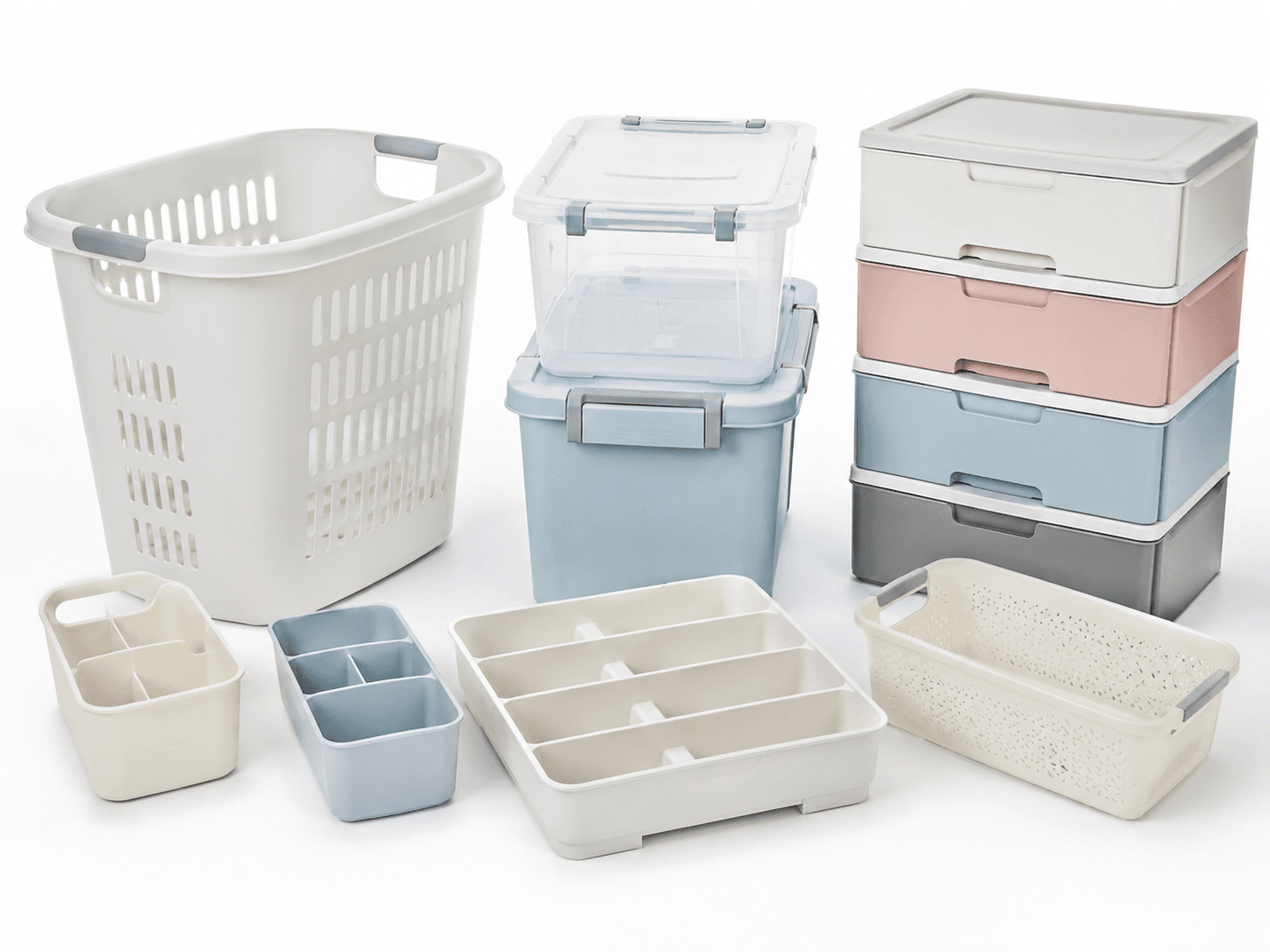
Storage products are often produced in very high volumes and may range from small organizers to relatively large plastic containers.
تشمل التطبيقات النموذجية:
- Storage boxes
- Drawer organizers
- Clothes organizers
- Laundry baskets
- Utility containers
- Shelving accessories
- Tool organizers
- Household bins
These products may appear simple, but large injection molded parts can create significant engineering challenges.
Long flat walls are particularly susceptible to warpage. Large ribs may create sink marks, while insufficient stiffness can make a container feel weak or inexpensive.
Designers often use rib networks, rolled edges, corner radii, and structural geometry to increase rigidity without simply increasing wall thickness.
Structural Design Considerations
| Design Feature | Engineering Purpose |
| Rib Network | Increase stiffness |
| Rounded Corners | Reduce stress concentration |
| Uniform Wall Thickness | Reduce sink and warpage |
| Draft Angle | Improve mold release |
| Stackable Geometry | Improve storage efficiency |
| Reinforced Handles | Improve load capacity |
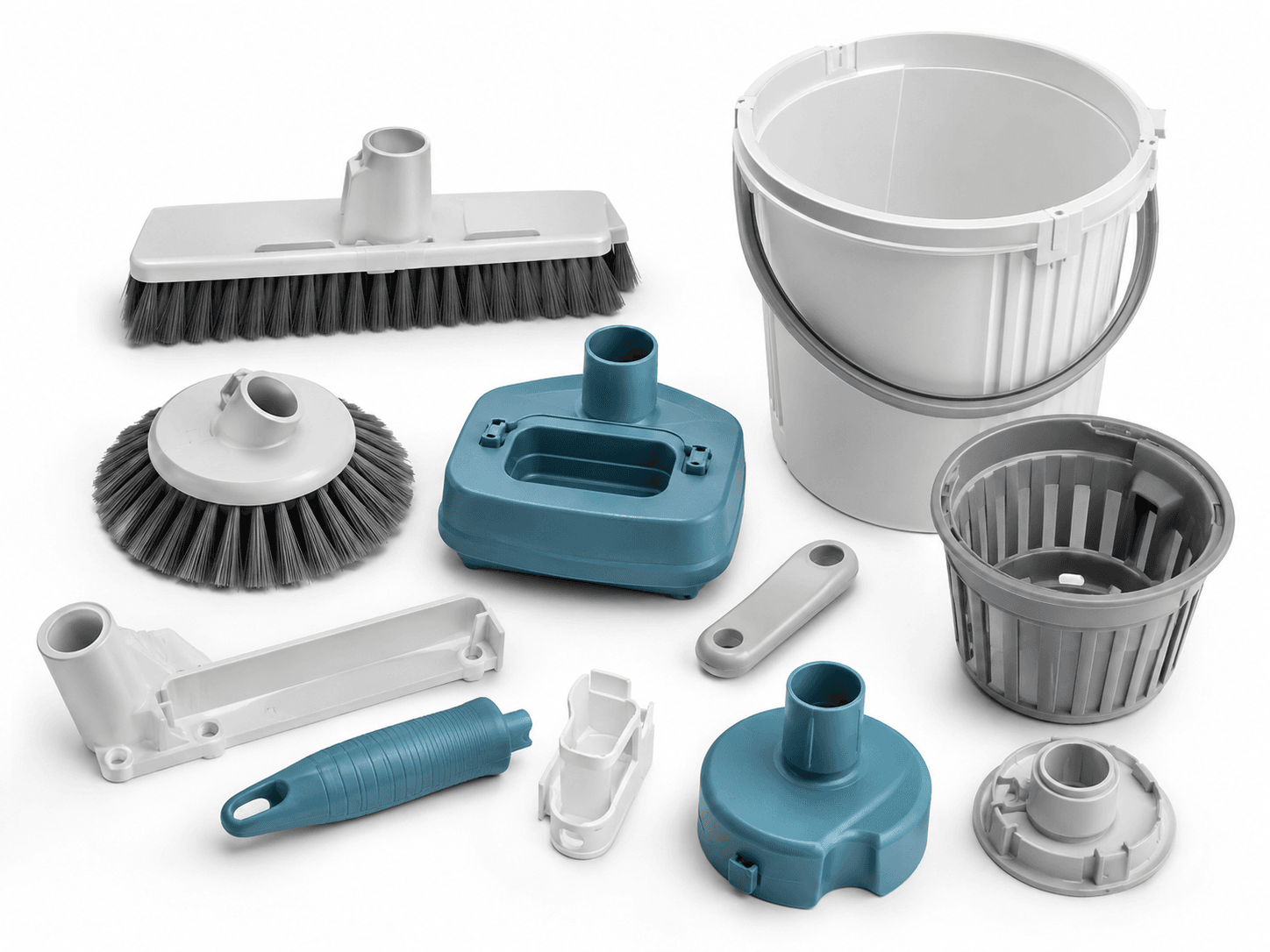
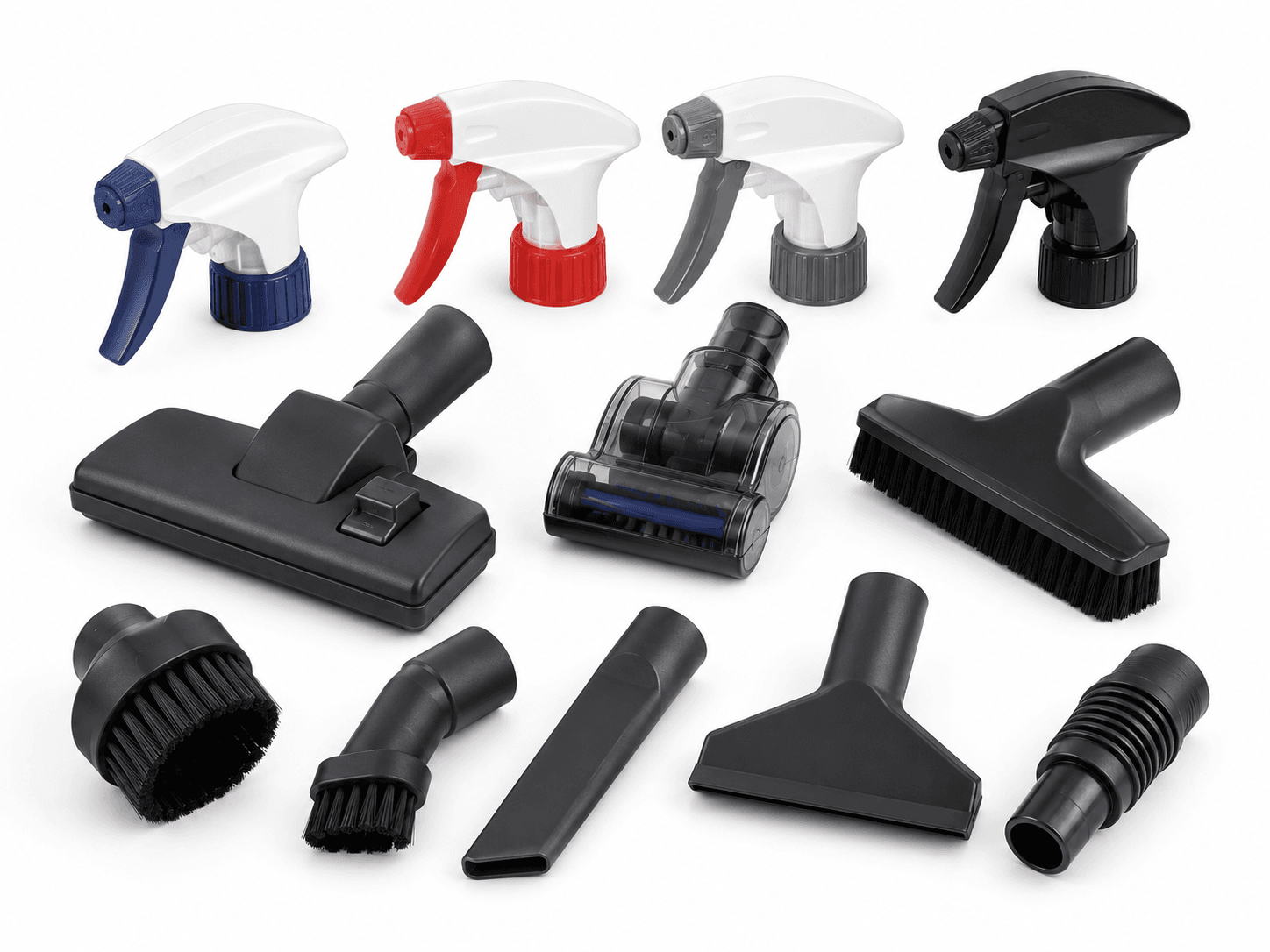
4. Cleaning and Laundry Products
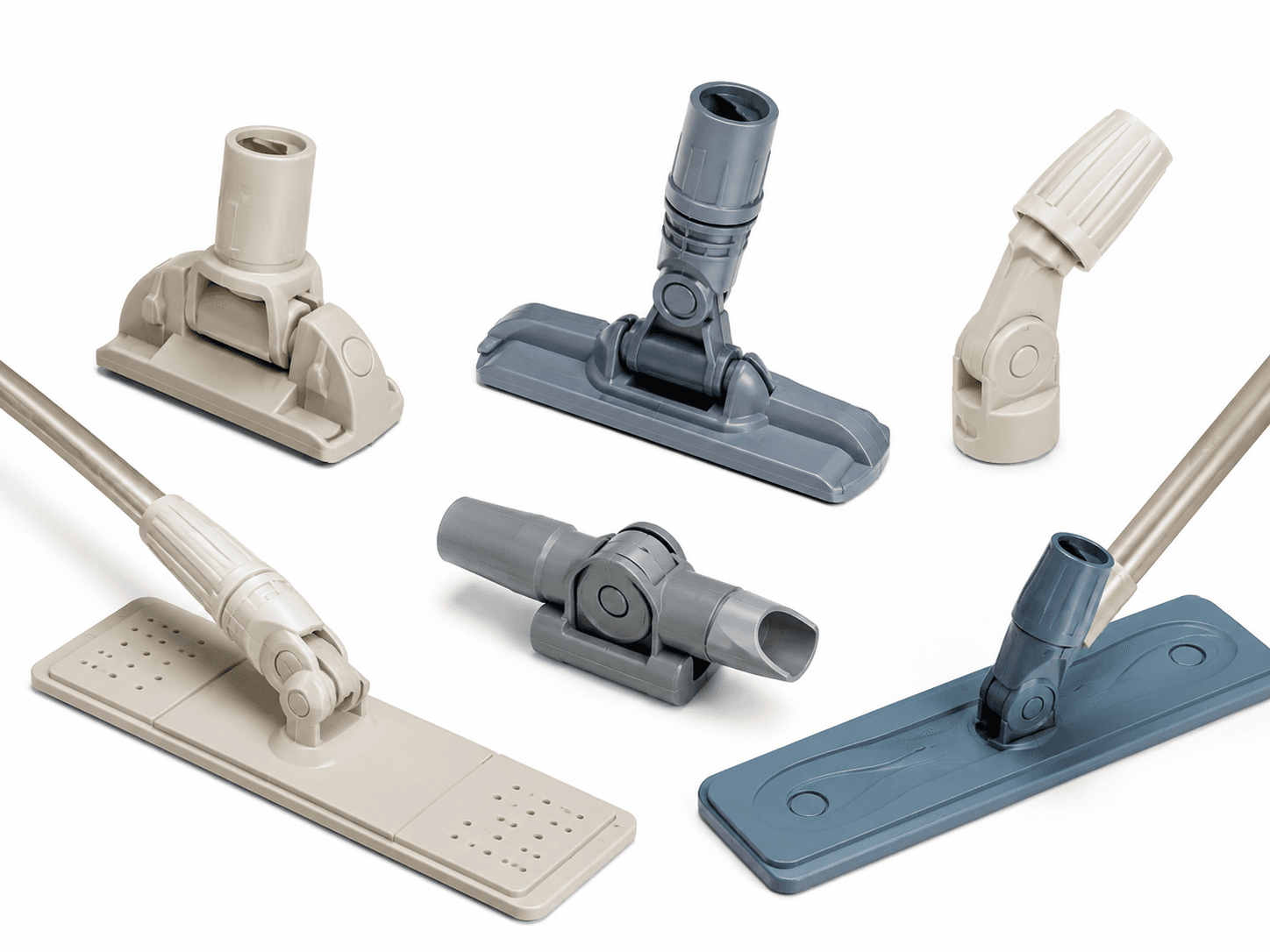
Injection molding is extensively used for cleaning and laundry products because these components often require good chemical resistance, toughness, and economical mass production.
Applications include:
- Mop components
- Bucket handles
- Brush housings
- Spray bottle components
- Cleaning tool connectors
- Vacuum cleaner accessories
- Laundry accessories
- Detergent dispensing components
These products may repeatedly contact detergents, cleaning agents, water, and household chemicals.
Material compatibility must therefore be evaluated against the actual chemicals used during service. Stress cracking can occur when a polymer that performs well mechanically is exposed to an incompatible chemical under load.
Snap-fit connections, threaded interfaces, and overmolded soft-grip areas are also common in cleaning products.
5. Bathroom and Household Utility Components
Bathrooms and utility areas contain numerous injection molded products exposed to humidity, water, cleaning chemicals, and frequent handling.
Examples include:
- Soap dispenser housings
- Toothbrush holders
- Shower accessories
- Drain components
- Utility hooks
- Bathroom organizers
- Toilet accessories
- Water-control housings
These parts often require smooth surfaces that are easy to clean while maintaining resistance to moisture and cleaning chemicals.
For visible bathroom products, surface quality can be just as important as structural performance. High-gloss mold polishing, matte textures, color matching, and molded decorative details can all be used to achieve the desired appearance without extensive secondary processing.
6. Material Selection for Household Injection Molding
Household products cover such a wide range of applications that no single polymer is suitable for every component.
Common material candidates include:
| مادة | الخصائص الرئيسية | Typical Household Applications |
| بي بي | Chemical resistance, economical | Storage, kitchenware, cleaning products |
| إيه بي إس | Good appearance and toughness | Appliance housings |
| بولي كاربونات / أكريلونتريل بوتادين ستيرين | Impact resistance + dimensional stability | Premium appliance housings |
| حاسوب شخصي | High impact performance | Durable transparent components |
| POM | Low friction, wear resistance | Gears and mechanisms |
| PA-GF | Strength and stiffness | Structural appliance parts |
| بي بي تي | Electrical properties, dimensional stability | Switches and electrical components |
| TPE | Flexible soft touch | Handles and seals |
Engineering-material suppliers offer ABS, PBT and other thermoplastics specifically for appliance and electrical applications, with material choice dependent on performance requirements.
Material selection should consider the complete operating environment, including temperature, impact, chemical contact, food contact, electrical requirements, appearance, and expected product life.
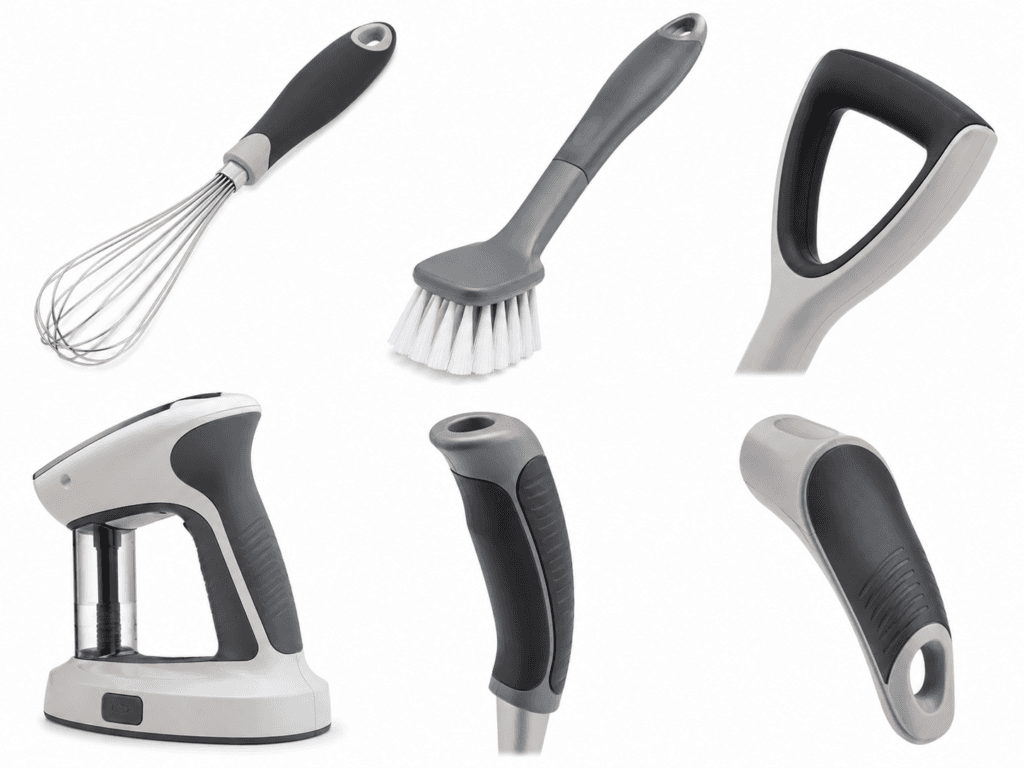
7. Overmolding and Soft-Touch Household Products
Many premium household products use more than one material.
TPE overmolding can provide:
- Soft-touch handles
- Improved grip
- Vibration reduction
- Sealing
- Impact protection
- Enhanced appearance
Common examples include kitchen utensil handles, cleaning tools, power appliance grips, toothbrush components, and household tools.
The substrate and overmolding material must have suitable adhesion characteristics. Mold design must also control material positioning, shut-off surfaces, and dimensional tolerances to prevent flash or incomplete coverage.
8. Mold Design for Household Plastic Parts
Household products often have aggressive cost targets, which makes efficient mold design especially important.
Key considerations include:
Multi-Cavity Tooling
Small parts such as clips, knobs, caps, and connectors can often use multi-cavity molds to increase output.
Hot Runner Systems
For suitable high-volume products, hot runners can reduce runner waste and support automated production.
Cooling Optimization
Cooling frequently represents a significant portion of the molding cycle. Balanced cooling helps reduce cycle time while controlling shrinkage and warpage.
Sliders and Lifters
Household products may contain side openings, locking hooks, handles, or snap-fit features requiring undercut mechanisms.
Surface Texture
Mold polishing and texturing determine the final appearance of many visible household products.
9. Flame Resistance and Electrical Safety
Plastic parts used near electrical components, heating systems, motors, or power supplies may require additional safety consideration.
UL 94 is widely used to characterize the flammability behavior of plastic materials used in components and parts of devices and appliances. Importantly, the rating relates to defined test conditions and material thickness; it should not be treated as a universal guarantee of complete product fire safety.
For household electrical appliances, the relevant end-product standard must be considered together with material properties, component geometry, electrical spacing, heat exposure, and operating conditions.
10. Common Household Injection Molding Defects
High-volume household products require stable appearance and dimensions.
| Defect | Common Cause | Engineering Solution |
| Sink Marks | Excessive local thickness | Optimize ribs and bosses |
| Warpage | Uneven cooling/shrinkage | Improve cooling and filling |
| Weld Lines | Multiple flow fronts | Optimize gate location |
| Flash | Mold clearance or high pressure | Improve tooling/process |
| Short Shot | Insufficient filling | Optimize flow path |
| Color Variation | Material/process inconsistency | Improve material control |
| Surface Marks | Mold/process condition | Optimize tool finish |
DFM review and mold-flow simulation can identify many of these risks before tooling is manufactured.
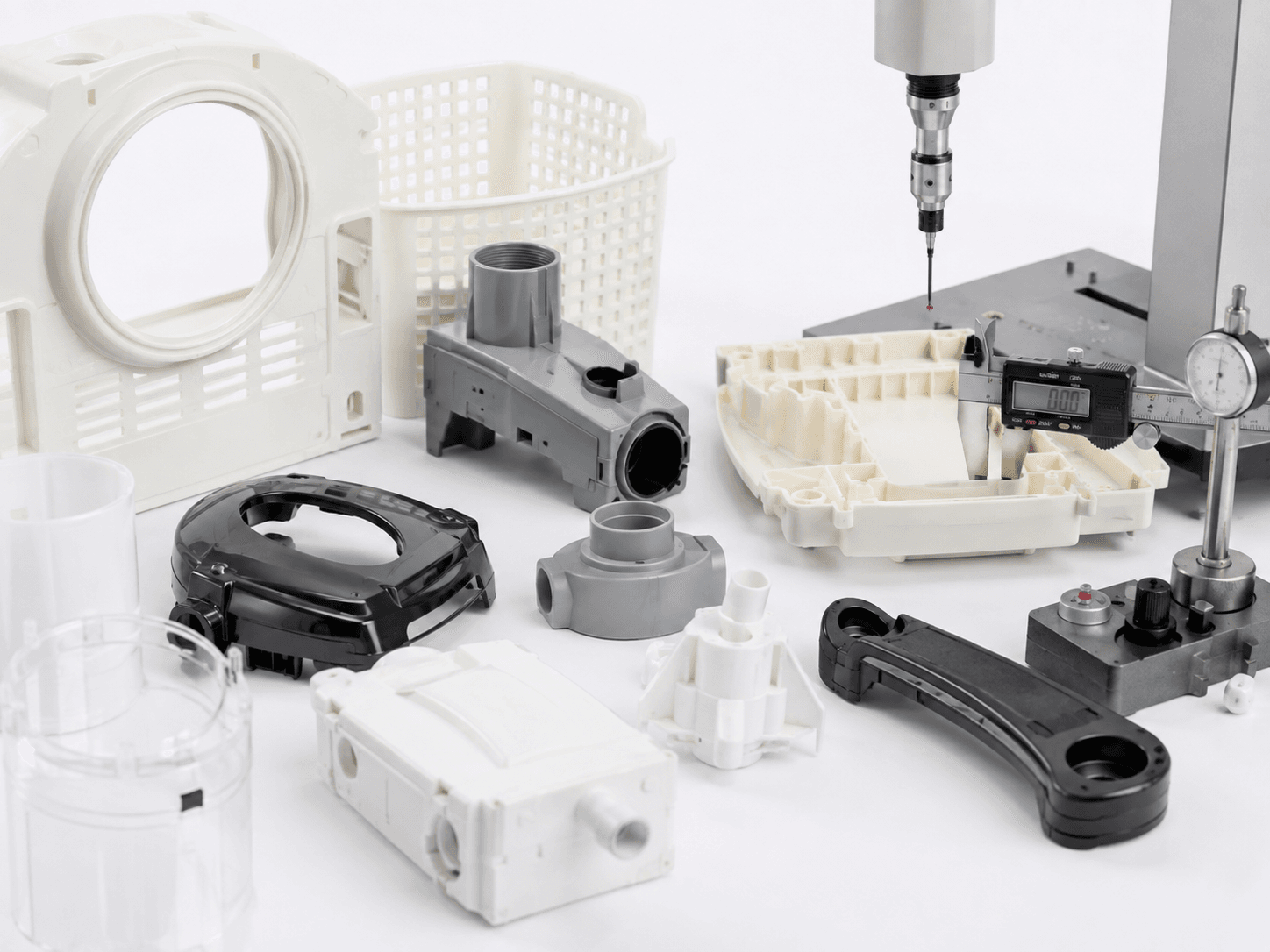
11. Quality Control for Household Plastic Parts
Household products may be inexpensive individually, but production quantities can be extremely high. A small defect rate can therefore create substantial scrap and assembly costs.
Common inspection methods include:
- Dimensional inspection
- Visual surface inspection
- Color comparison
- Assembly testing
- Drop testing
- Load testing
- Torque testing
- Leak testing
- Functional life-cycle testing
Electrical appliances may require additional safety testing according to the applicable market and end-product requirements.
12. Sustainability and Household Product Design
Sustainability is becoming increasingly relevant to household goods and appliance development. Material suppliers are developing solutions around lightweighting, part integration, recycled content, and design for recyclability.
Practical strategies can include:
- Reducing unnecessary wall thickness
- Designing fewer components
- Using mono-material structures where practical
- Selecting recyclable thermoplastics
- Reducing runner waste
- Designing products for repair or disassembly
- Evaluating recycled materials where specifications allow
For food-contact products, recycled materials require additional regulatory consideration. FDA, for example, provides specific guidance regarding recycled plastics proposed for food-contact applications.
Why Choose Samgo for Household Injection Molding?
Household product manufacturing requires a balance between appearance, durability, production efficiency, and cost.
Samgo supports custom household plastic projects from product engineering through tooling and mass production.
| Capability | Customer Benefit |
| Product Design Support | Improve manufacturability |
| DFM Analysis | Identify tooling risks early |
| Moldflow Analysis | Optimize filling and warpage |
| Precision Mold Manufacturing | Stable part dimensions |
| Multi-Cavity Tooling | Improve production efficiency |
| Injection Molding | Consistent mass production |
| Quality Inspection | Verify appearance and function |
Applications can include appliance housings, kitchenware, storage products, cleaning equipment, bathroom products, utility components, and other custom household plastic parts.
Frequently Asked Questions
What plastics are commonly used for household injection molding?
PP, ABS, PC/ABS, PC, POM, PA, PBT, and TPE are widely considered. The correct material depends on mechanical strength, temperature, chemicals, electrical requirements, appearance, and regulatory requirements.
Which plastic is suitable for household appliance housings?
ABS and PC/ABS are common candidates because they can provide good appearance, toughness, and dimensional performance. Electrical or heat-related applications may require specialized grades.
Can household kitchen products be injection molded?
Yes. Storage containers, measuring products, kitchen accessories, appliance components, and many other kitchen products are produced by injection molding. Food-contact compliance must be evaluated for the target market.
Can soft rubber grips be molded directly onto household products?
Yes. Two-shot molding or TPE overmolding can create integrated soft-touch grips when the materials and product geometry are compatible.
Conclusion
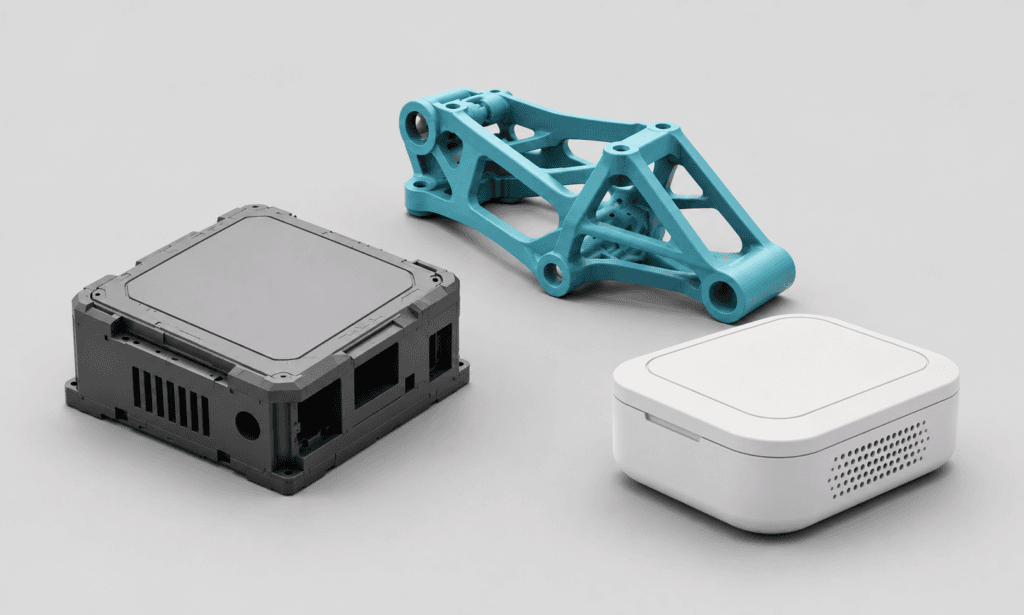
Injection molding enables household manufacturers to produce attractive, durable, functional, and cost-effective plastic products at high production volumes. Applications range from kitchenware and storage containers to cleaning equipment, bathroom products, appliance housings, electrical components, and internal mechanisms.
The requirements of each product can differ considerably. A simple storage organizer may prioritize low cost and stiffness, while a kitchen component may require food-contact compliance and heat resistance. An electrical appliance housing may require impact resistance, dimensional stability, flame performance, and compliance with applicable appliance safety requirements.
Successful household injection molding therefore begins with understanding the actual product environment. Material selection, wall thickness, ribs, snap fits, surface finishing, mold structure, cooling, production efficiency, and quality validation should be considered together.
By combining product DFM, material engineering, Moldflow simulation, precision mold manufacturing, and controlled injection molding, manufacturers can develop household plastic components that provide reliable performance while maintaining competitive production costs.
احصل على أحدث سعر؟ سنرد عليك في أقرب وقت ممكن (خلال 12 ساعة)
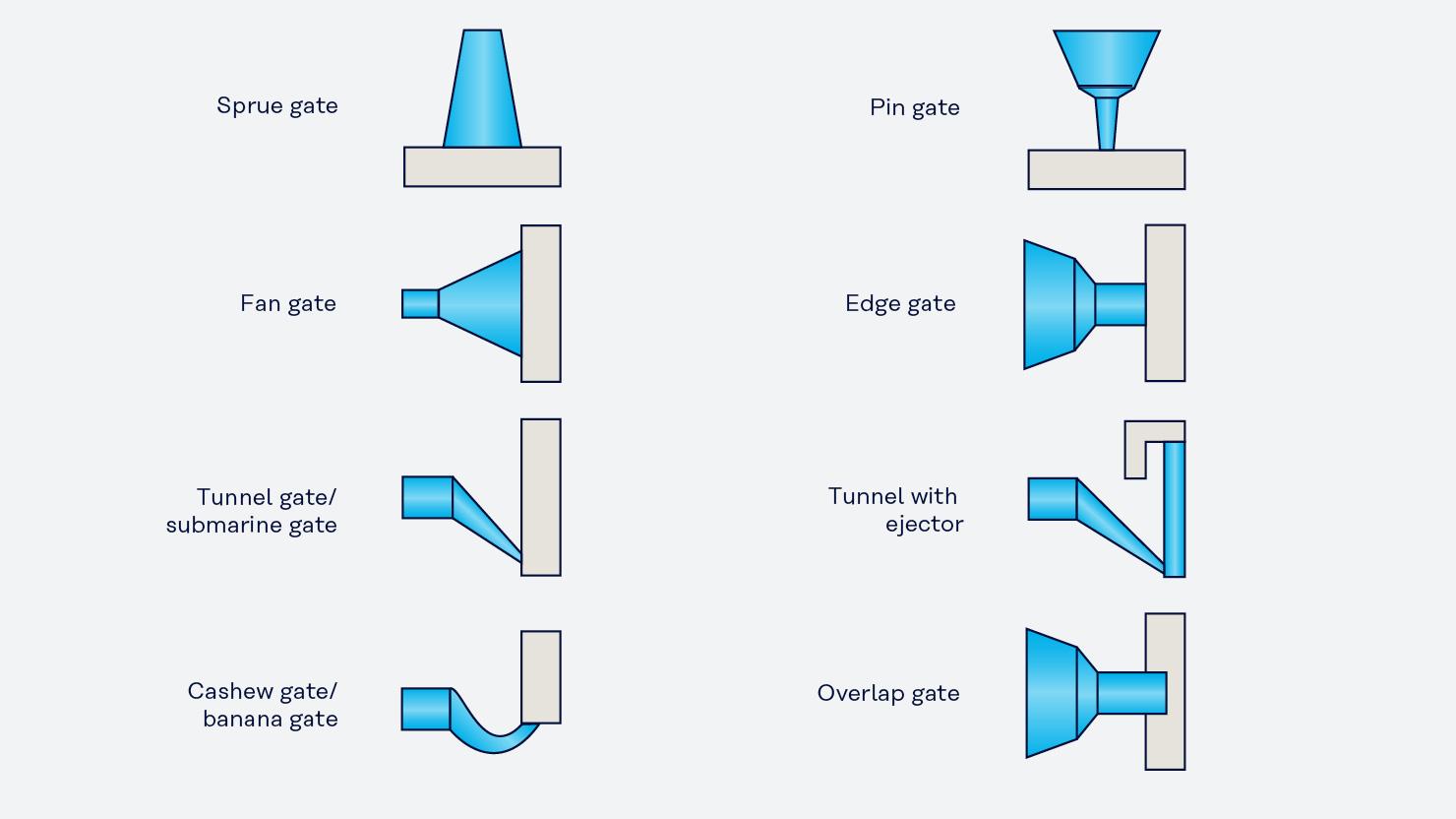
أنواع بوابات القولبة بالحقن البلاستيكي: الاختيار، ومبادئ التصميم، والمزايا، والتطبيقات
تصميم البوابة يُعد أحد أكثر جوانب هندسة قوالب الحقن البلاستيكية أهمية. وعلى الرغم من أن البوابة عادةً ما تكون أصغر معالم نظام التغذية، إلا أن لها تأثيراً كبيراً على تدفق المصهور، وضغط الكبر، وكفاءة التبريد، ومظهر القطعة، وقت الدورة، والجودة الكلية للمنتج.
يمكن أن يتسبب البواب المصمم بشكل سيئ في حدوث العديد من عيوب القولبة، بما في ذلك الحقن الناقص، وعلامات الانكماش، وخطوط اللحام، والتدفق النفاث، وعلامات الحرق، وبقايا البوابة المفرطة، وانهيار الجزء. وفي المقابل، يساعد اختيار نوع البوابة وموقعها المناسب في ضمان التعبئة المتوازنة، ودقة الأبعاد الثابتة، والإنتاج الفعال.
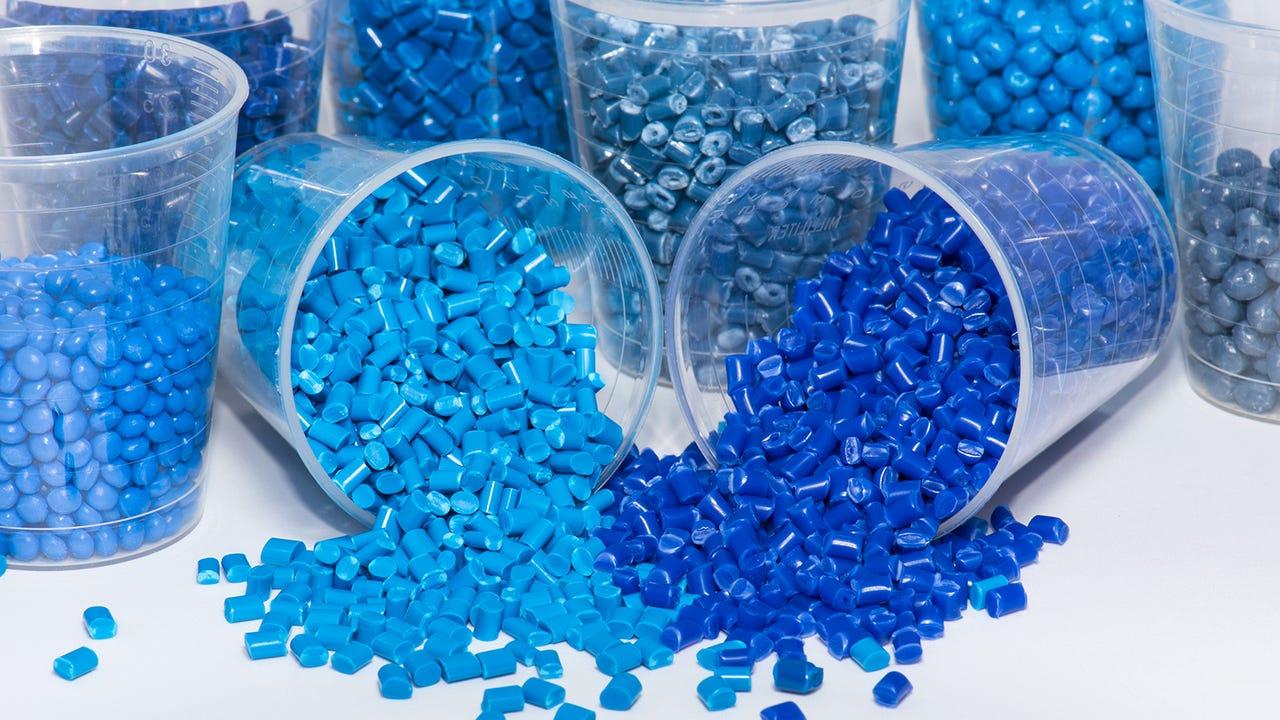
مواد البولي بروبيلين (PP): الأنواع، الدرجات، الخصائص، والتطبيقات
البولي بروبيلين (PP) هو أحد أكثر المواد البلاستيكية الحرارية استخداماً في العالم، حيث يستحوذ على حصة كبيرة من إنتاج البلاستيك العالمي. بفضل توازنه الممتاز بين الخواص الميكانيكية، ومقاومته الكيميائية، وخصائصه خفيفة الوزن، وفعاليته من حيث التكلفة، أصبح البولي بروبيلين المادة المفضلة لعدد لا يحصى من منتجات القولبة بالحقن عبر التطبيقات السيارات، المنزلية، الطبية، التعبئة والتغليف، الكهربائية، والصناعية.
يتوفر البولي بروبيلين الحديث في العديد من الدرجات والتركيبات المختلفة. ويمكن للشركات المصنعة الاختيار من بين البولي بروبيلين متجانس البوليمر، والبولي بروبيلين كوبوليمر عشوائي، والبولي بروبيلين كوبوليمر مقاوم للصدمات، والبولي بروبيلين المقوى بالألياف الزجاجية، والبولي بروبيلين المحشو بالمعادن، والبولي بروبيلين المثبط للهب، والبولي بروبيلين المثبت ضد الأشعة فوق البنفسجية، والبولي بروبيلين المخصص للطعام، وذلك اعتماداً على متطلبات المنتج.
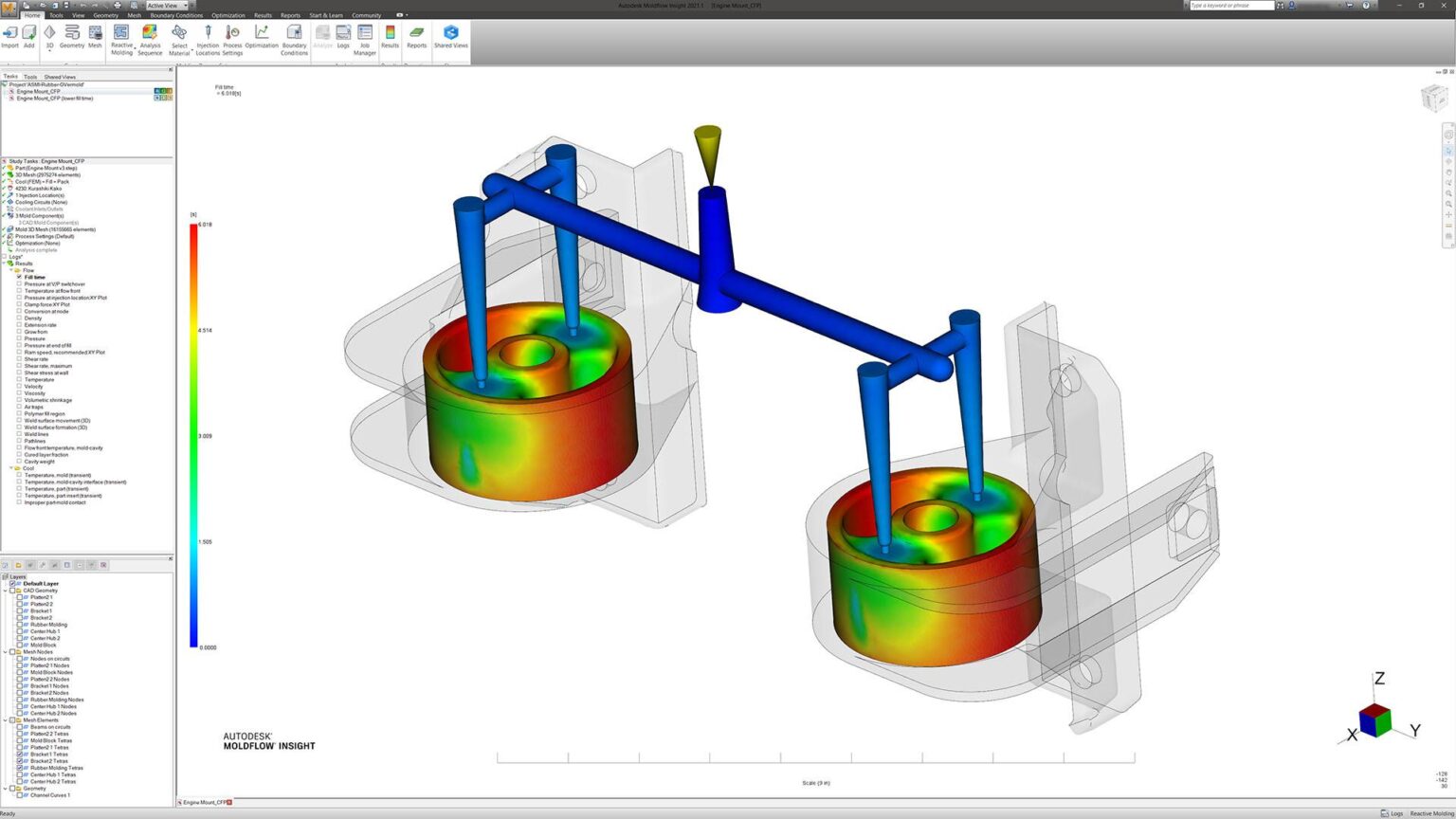
تحليل تدفق القولون بالحقن: الدليل الشامل لمحاكاة مولد فلو للأجزاء البلاستيكية
في تطوير منتجات البلاستيك الحديثة، لم تعد صناعة القوالب تعتمد فقط على الخبرة الهندسية. لقد أصبحت الهندسة بمساعدة الكمبيوتر (CAE) جزءاً أساسياً من عملية القولبة بالحقن، مما يتيح للمهندسين التنبؤ بعيوب القولبة المحتملة قبل تصنيع القالب. ومن بين هذه التقنيات، يُعد تحليل تدفق قوالب الحقن، والذي يُشار إليه غالباً بتحليل "مولد فلو" (Moldflow)، أحد أكثر الأدوات الهندسية قيمة لتقليل مخاطر التطوير، وتقصير أوقات التوريد، وتحسين جودة الأجزاء.